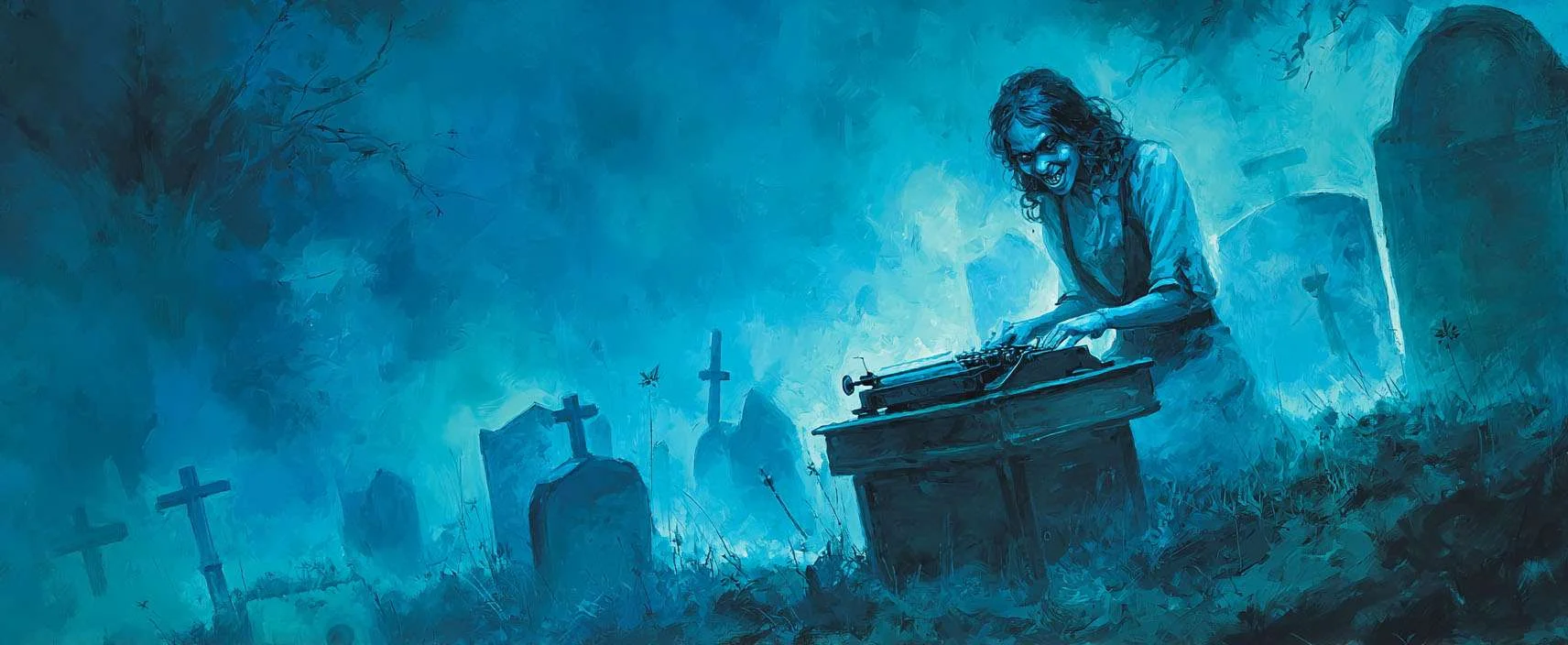
Go Short Or Go Home by Petra Lang

29 September 2025 · 1 min read
This year, my submission to Twisted 50 was only 39 words long. That’s all it took to shock people:
She stood in front of her child’s room, the baby monitor crackling in her hand.
A scared whisper came through:
“Don’t come in yet… it’s still playing with me.”
She froze.
Her son had been buried three days ago.
I didn’t set out to write something so short, but I’ve always been fascinated by how little it takes to deliver a gut-punch. The most famous example is the six-word story often attributed to Hemingway: For sale: baby shoes, never worn. It’s powerful in its simplicity. And while many credit Hemingway, the story existed long before him. What matters is how it lingers and how the absence of detail forces your imagination to rush in and do the work.
As a screenwriter, I think about that all the time. The first rule of the industry is: no one likes to read. Executives, producers, agents are drowning in scripts. The trick is to make every line count. Use brevity as an advantage.
I’ve submitted work to Twisted 50 before and never made it through. This year, I decided to do something different. Instead of sending in something sprawling, I went small. Stripped down. Ruthless with the words.
And maybe this is why the story works: because it doesn’t try to do everything. It just opens the door, lets the reader peek in, and leaves them unsettled long after the words are gone.
Written by
Petra Langa UK-based screenwriter telling character-driven, genre-leaning features. After dropping out of film school (twice), she travelled across Europe, lived in Denmark, and eventually settled in the UK — working on sets, at the London Screenwriters' Festival, and shooting her sci-fi short film. She’s participated in schemes like Talent Campus and the Scriptfella Program. Born into a 70+ person Swabian family in rural post-communist Romania, she grew up in a rapidly changing world. American genre films, suddenly flooding Eastern European TV in the 90s, became both escape and a way to make sense of the chaos. She now uses genre to tell human stories about detachment, identity, and the need for connection. Petra's other passions include pouring latte art and fire-walking.